Using the API
Use the Palatial API to use the Isaac Sim plugin or create SimReady 3D assets from images, text, or CAD files, track generation progress, and download results programmatically. All routes below use your API key and live under:
https://dashboard.palatial.cloud/api/v1/external/Contact Palatial if you need a sandbox or staging environment for integration testing.
Creating an API key
Section titled “Creating an API key”API keys are created per workspace. A key can only read and generate assets inside the workspace it was created in, and only workspace members (or organization admins) can create one. See Roles and permissions.
-
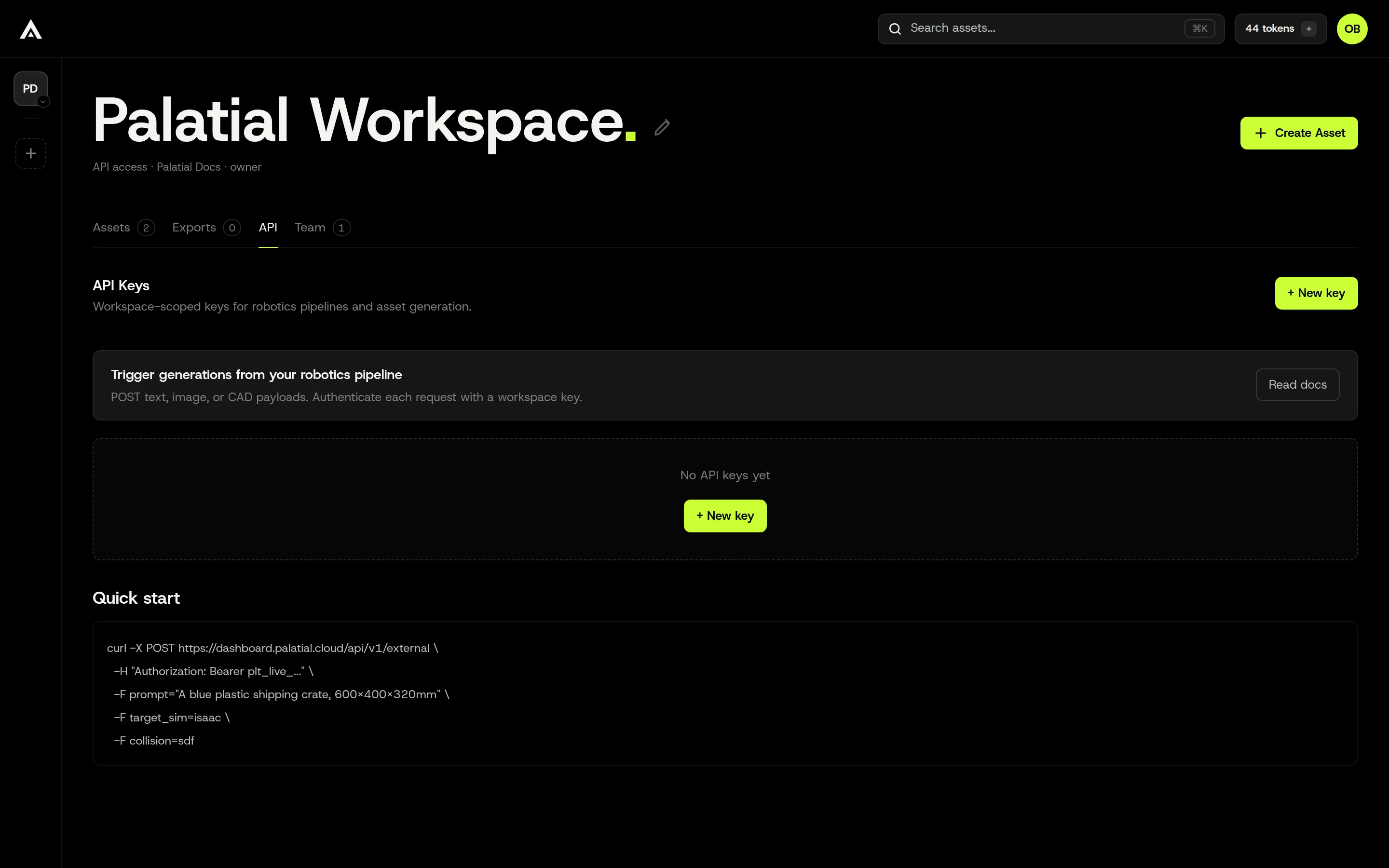
Open the workspace in the dashboard and select the API tab next to Assets, Exports, and Team.
-
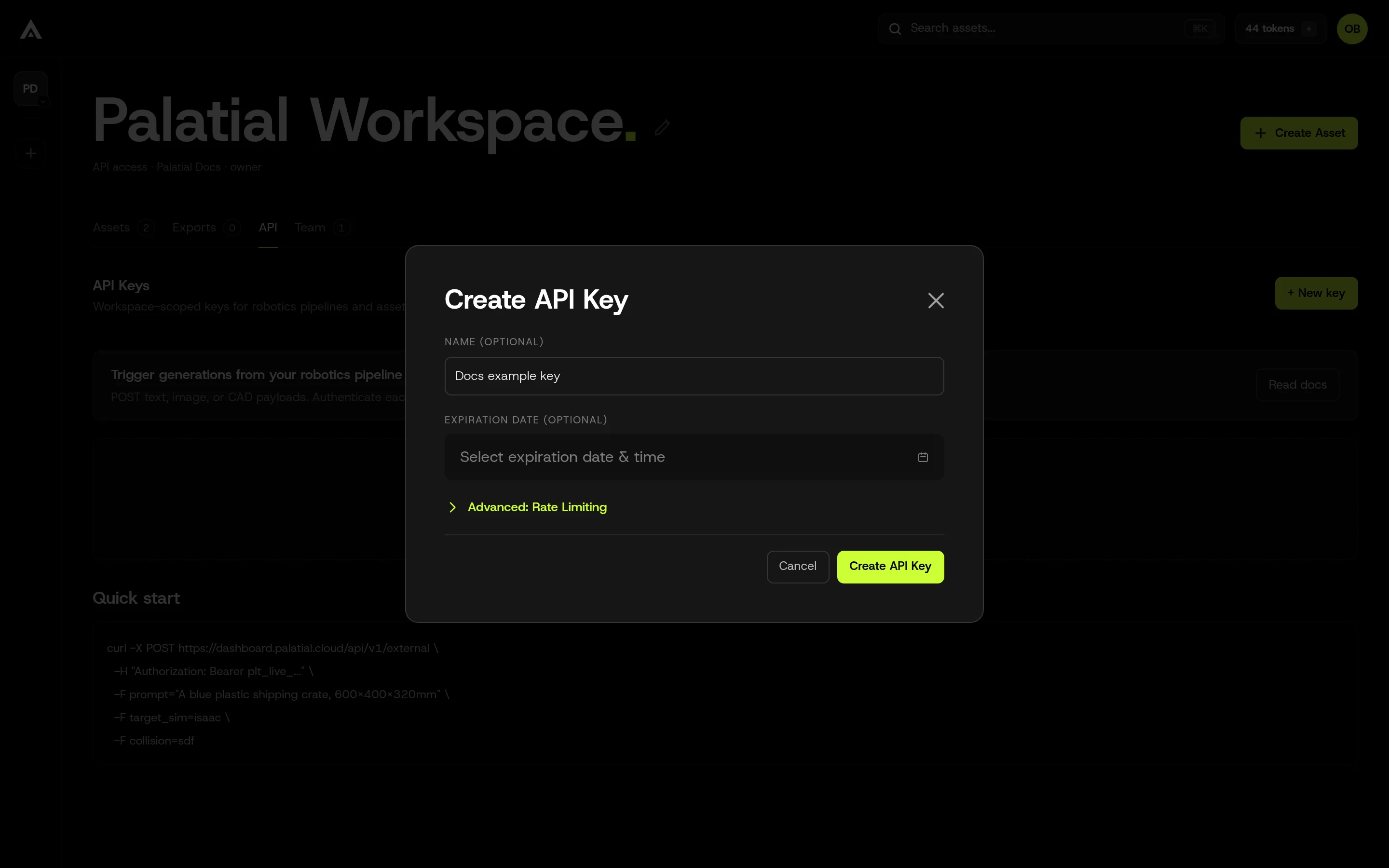
Click New key. Give the key a name so you can recognise it later (for example the pipeline or machine that will use it). The expiration date and rate limits are optional.
-
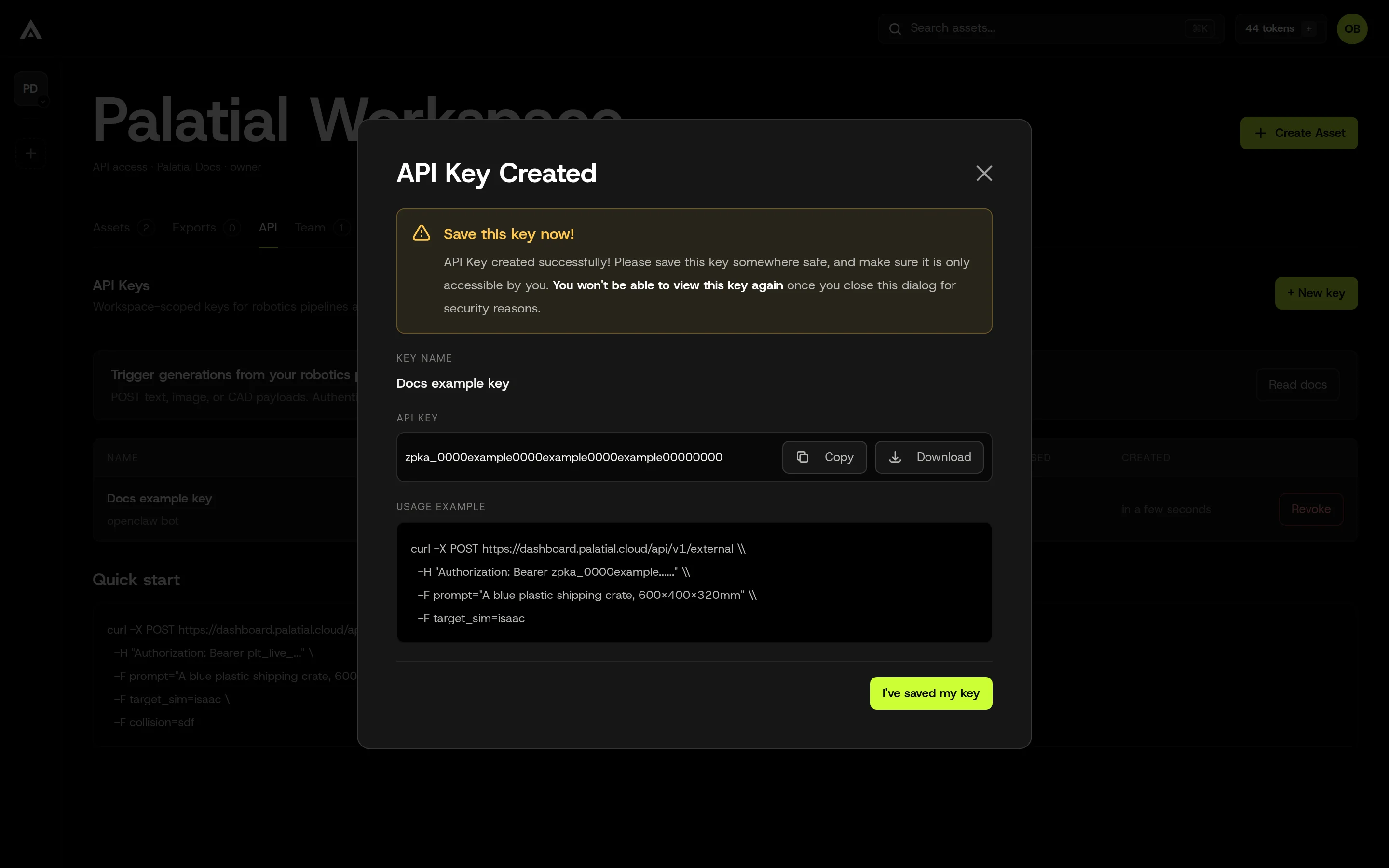
Click Create API Key. The key is shown once. Copy it and store it in your secret manager now; after you close this dialog it cannot be displayed again.
-
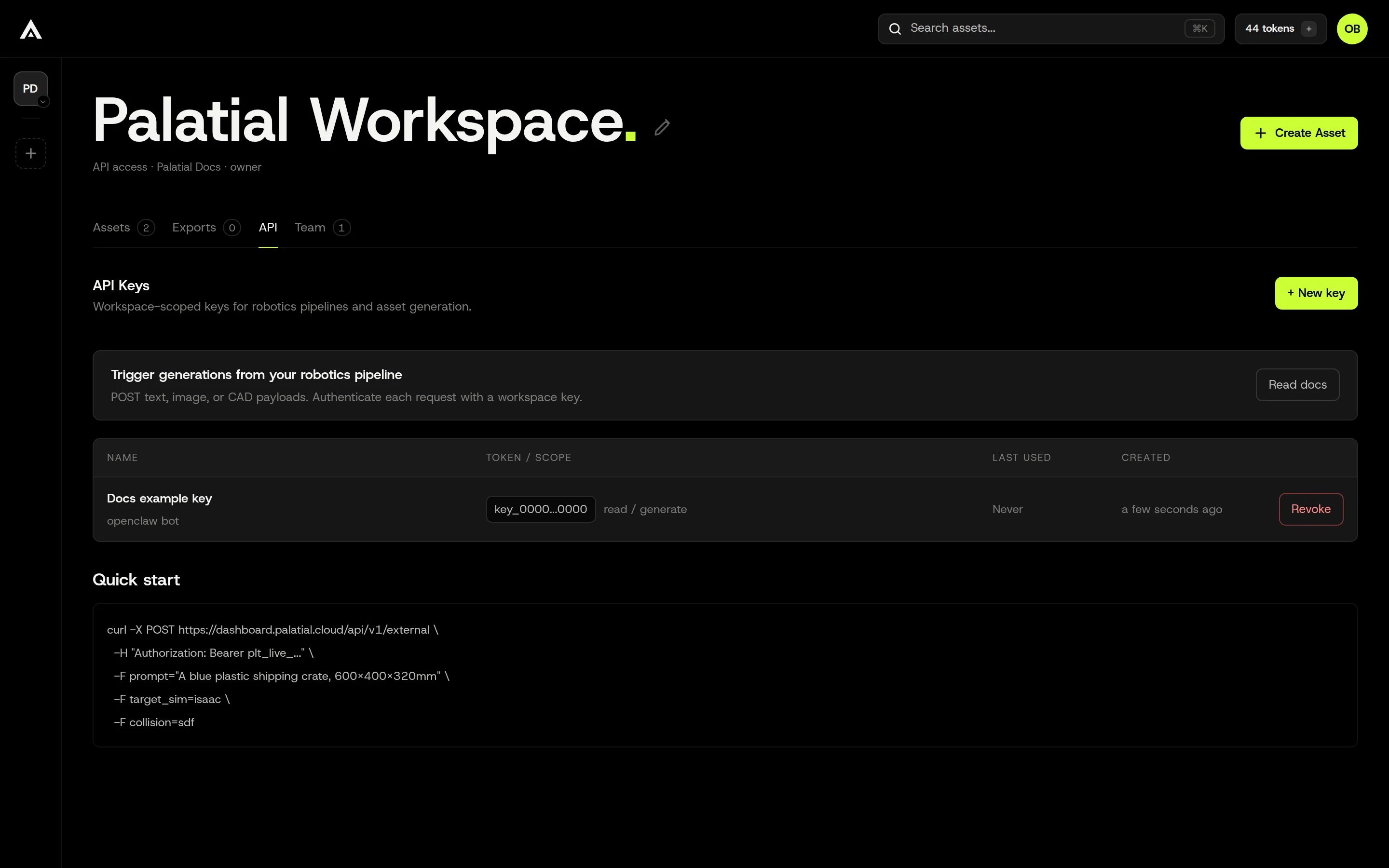
Click I’ve saved my key. The key now appears in the list with a masked value, its scope, and when it was last used. Revoke removes it immediately; requests using a revoked key return 403.
Send the key on every request using one of:
- Header:
x-api-key: YOUR_API_KEY - Header:
Authorization: Bearer YOUR_API_KEY - Query:
?api_key=YOUR_API_KEY
Never paste a key into a chat message, screenshot, public issue, or source file. If a key may have been exposed, revoke it from the API tab and create a new one.
Typical flow
Section titled “Typical flow”- Create an asset with one of the generation endpoints (Image → Sim, Text → Sim, or CAD → Sim).
- Poll status until the asset is READY (or handle PROCESSING_FAILED).
- Download the SimReady export ZIP or individual outputs (mesh, texture, collisions, etc.).
Feature highlights
Section titled “Feature highlights”- Generated textures support 2K, 4K, and 8K requests. The confirmation card and API response show the settings used for each asset.
- Texture optimization can reduce oversized maps without upscaling smaller maps.
- Geometry reduction supports automatic quality selection and an optional explicit target for integrations that need tighter output-size control.
- Asset Variants: branch a successful asset into a new independent asset by describing the desired change in feedback.
Authentication & access
Section titled “Authentication & access”| Key type | What you can access |
|---|---|
| Workspace API key (recommended) | Assets and workspaces tied to that workspace |
| User-scoped key | Assets you own in your workspaces |
| Master key (enterprise) | Broader access; some calls require an explicit owner field |
If you receive 403 Forbidden, check that the asset belongs to the workspace attached to your API key and that you have the required workspace access and any applicable generation balance.
HTTP status codes
Section titled “HTTP status codes”| Code | Meaning |
|---|---|
| 200 | Success |
| 201 | Resource created |
| 307 | Redirect (export download , follow with -L in cURL) |
| 400 | Invalid request (check field names and values) |
| 403 | Invalid API key or insufficient permissions/credits |
| 404 | Asset or workspace not found |
| 409 | Request conflicts with the current resource state |
| 500 | Server error , retry with backoff |
| 503 | Service temporarily unavailable , retry with backoff |
Asset lifecycle
Section titled “Asset lifecycle”When you create or submit an asset, status.status moves through states like:
| Status | Meaning |
|---|---|
| INIT | Created but not yet submitted (Text → Sim may start here briefly) |
| SUBMITTED | Queued for processing |
| QUEUED | Accepted, waiting to start |
| PROCESSING_IMPORT | Generation in progress |
| PROCESSING_PAUSED | Paused mid-pipeline (uncommon for API flows) |
| READY | Done , outputs are available to download |
| PROCESSING_FAILED | Failed , check status.displayText on the asset |
| PROCESSING_CANCELED | Canceled |
Poll GET …/status every few seconds until you see READY or a terminal failure state. The status object may also include progress, completedSteps, totalSteps, and displayText for a coarse progress indicator.
Typical workflow (Image → Sim)
Section titled “Typical workflow (Image → Sim)”# 1a. Create and submit - If using a Single Imagecurl -X POST "https://dashboard.palatial.cloud/api/v1/external/assets/create/imagetosim" \ -H "x-api-key: YOUR_API_KEY" \ -F "name=Storage Bin" \ -F "description=A rigid plastic storage bin with a hinged lid"
# 1b. Create and submit - If using Multiviewcurl -X POST "https://dashboard.palatial.cloud/api/v1/external/assets/create/imagetosim" \ -H "x-api-key: YOUR_API_KEY" \ -F "front=@chair_front.jpg" \ -F "left=@chair_left.jpg" \ -F "back=@chair_back.jpg" \ -F "right=@chair_right.jpg" \ -F "name=Office Chair" \ -F "description=Black mesh office chair with armrests" \ -F "shape_model=auto"
# Response includes "id" , save it as ASSET_ID
# 2. Poll until READYcurl "https://dashboard.palatial.cloud/api/v1/external/assets/ASSET_ID/status" \ -H "x-api-key: YOUR_API_KEY"
# 3. Download SimReady exportcurl -L -o export.zip \ "https://dashboard.palatial.cloud/api/v1/external/assets/ASSET_ID/media/export" \ -H "x-api-key: YOUR_API_KEY"Assets
Section titled “Assets”Base path: /api/v1/external/assets
List assets
Section titled “List assets”GET /api/v1/external/assets
Returns a paginated list of assets in your workspace. Query: pass a filter object (JSON) with optional fields:
| Field | Description |
|---|---|
| where.workspace | Filter by workspace ID |
| where.search | Search by name |
| where.status.status | Filter by status (e.g. READY) |
| limit | Page size (default 10) |
| skip | Offset for pagination |
| sort | { “createdAt”: -1 } or { “updatedAt”: -1 } |
curl -G "https://dashboard.palatial.cloud/api/v1/external/assets" \ -H "x-api-key: YOUR_API_KEY" \ --data-urlencode 'filter={"limit":20,"sort":{"updatedAt":-1}}'Get asset
Section titled “Get asset”GET /api/v1/external/assets/{id}
Returns the full asset record: name, type, parameters, status, export info, and metadata.
Create asset (JSON)
Section titled “Create asset (JSON)”POST /api/v1/external/assets
Creates a draft asset without starting generation. You must call Submit separately. Required: name, workspace Optional: description, parameters, pipeline options (mesh_density, shape_model, texture_model, engine, etc.)
Update asset
Section titled “Update asset”PATCH /api/v1/external/assets/{id}
Update name, description, parameters, or other metadata on an existing asset.
Submit asset
Section titled “Submit asset”POST /api/v1/external/assets/{id}/submit
Starts or restarts processing for an existing asset. Body (optional JSON):
| Field | Description |
|---|---|
| type | Pipeline type, e.g. imagetosimready, cadtosimready |
| retry | Retry reason string (stored on the asset) |
Reprocess from a pipeline stage
Section titled “Reprocess from a pipeline stage”POST /api/v1/external/assets/{id}/reprocess
Re-runs an existing asset starting from a specific pipeline stage. This keeps the same asset ID and asset type, writes reprocess controls onto the asset, and submits it for processing again. Use this when you want to regenerate one step, such as shape or texture, without creating a brand-new asset. Body (JSON):
| Field | Required | Description |
|---|---|---|
| from | Yes | Stage key to re-run from, e.g. shape-generation, parts-gen, texture, physics, validation-playback |
| mode | No | step stops after the requested stage; auto runs downstream stages automatically. Defaults to step. |
| stopAfter | No | Explicit stage to stop after. Defaults to from when mode is step. |
| sourceRunId | No | Exact prior product run whose artifacts should seed this reprocess. |
| destination | No | overwrite updates the current asset in place; variant creates a product variant run on the same asset. Defaults to overwrite. |
| feedback | No | Optional instruction for the regenerated stage. Max 4,000 characters. |
Example , regenerate texture only and pause:
curl -X POST "https://dashboard.palatial.cloud/api/v1/external/assets/ASSET_ID/reprocess" \ -H "x-api-key: YOUR_API_KEY" \ -H "Content-Type: application/json" \ -d '{ "from": "texture", "mode": "step" }'Example , regenerate from shape and continue downstream:
curl -X POST "https://dashboard.palatial.cloud/api/v1/external/assets/ASSET_ID/reprocess" \-H "x-api-key: YOUR_API_KEY" \-H "Content-Type: application/json" \-d '{ "from": "shape-generation", "mode": "auto" }'Response: 200 OK , returns the queued reprocess/run response for the asset. After calling this endpoint, poll GET /api/v1/external/assets/{id}/status or GET /api/v1/external/assets/{id}/pipeline-runs/current until the asset reaches READY, PROCESSING_PAUSED, PROCESSING_FAILED, or PROCESSING_CANCELED.
Errors:
- 400 , invalid stage key, invalid mode, missing asset workspace, or invalid reprocess request.
- 403 , the API key does not have submit access to the asset, or the workspace has insufficient credits/limits.
- 404 , asset not found.
Get asset status
Section titled “Get asset status”GET /api/v1/external/assets/{id}/status
Returns the current processing status. Use this to poll during generation. Response fields: status, progress, completedSteps, totalSteps, displayText, timestamps.
Cancel asset processing
Section titled “Cancel asset processing”DELETE /api/v1/external/assets/{id}/cancel-processing
Stops queued, active, or paused processing and moves the asset to PROCESSING_CANCELED. Cancellation is accepted while the asset is SUBMITTED, QUEUED, PROCESSING_IMPORT, PROCESSING_EDIT, MESH_GENERATED, TEXTURE_GENERATED, or PROCESSING_PAUSED. Repeating the request for an already canceled asset is safe.
curl -X DELETE \ "https://dashboard.palatial.cloud/api/v1/external/assets/ASSET_ID/cancel-processing" \ -H "x-api-key: YOUR_API_KEY"Response , 200 OK:
{ "success": true }After a successful request, poll GET /api/v1/external/assets/{id}/status until it returns PROCESSING_CANCELED. Errors:
- 400 , the asset is not currently processing.
- 403 , the API key does not have access to the asset.
Batch get statuses
Section titled “Batch get statuses”POST /api/v1/external/assets/statuses
Body: { “ids”: [“id1”, “id2”] } Returns status and export for each ID , useful when tracking many assets.
Detailed progress (optional)
Section titled “Detailed progress (optional)”GET /api/v1/external/assets/{id}/pipeline-runs/current
Returns per-stage progress for the current generation run (stages[], currentStageKey, overall run status). Use this if you need stage-level detail beyond the coarse /status response.
Generation
Section titled “Generation”One-shot endpoints that create and submit an asset in a single call.
Articulation modes
Section titled “Articulation modes”| What you want | Parameters |
|---|---|
| Single solid object | enable_parts_segmentation: false, no articulation flags |
| Rigid parts (no joints) | enable_parts_segmentation: true |
| Articulated parts (doors, wheels, etc.) | create_articulation: true (or agentic_articulation: true) |
Target simulator
Section titled “Target simulator”Set engine to one of: isaac_sim, mujoco, or newton. Default: Isaac Sim.
Image → Sim
Section titled “Image → Sim”POST /api/v1/external/assets/create/imagetosim
Content-Type: multipart/form-data Create a SimReady asset from one photo, or from multiple photos of the same object for multi-view reconstruction.
Images
Section titled “Images”Send either a single file or named view fields for multiview , not both.
| Field | Required | Description |
|---|---|---|
| file | One of file / view fields | Single input image (PNG, JPG, JPEG). |
| front | One of file / view fields | Front-facing photo of the object (PNG, JPG, JPEG). |
| left | One of file / view fields | Left-side photo (PNG, JPG, JPEG). |
| back | One of file / view fields | Back-facing photo (PNG, JPG, JPEG). |
| right | One of file / view fields | Right-side photo (PNG, JPG, JPEG). |
Multiview rules:
- Provide at least 2 of front, left, back, right.
- All four is recommended for best reconstruction quality.
- Omit any view you do not have.
- Each view is a separate form field , the field name is the view label.
Parameters
Section titled “Parameters”| Field | Required | Default | Description |
|---|---|---|---|
| name | Yes | , | Asset name (4–50 characters) |
| description | Yes | , | Object description / prompt (max 500 chars) |
| workspace | No | API key workspace | Workspace ID |
| engine | No | [isaac_sim] | Array of simulation engines: isaac_sim, mujoco, or newton. Omit this multipart field for the default single-engine request; send repeated engine fields when requesting multiple engines. |
| mesh_quality | No | high | low, medium, high |
| collision_quality | No | sdf | low, medium, high, x_high, sdf |
| shape_model | No | auto | auto, parametric |
| texture_model | No | auto | auto |
| decimation | No | Legacy adaptive behavior when omitted | Omit this field or pass true for adaptive reduction with triangle_count=auto; pass false to explicitly disable decimation. |
| decimation_mode | No | auto | auto for quality-driven adaptive decimation, or strict with exactly one explicit target. |
| decimation_target_faces | Strict only | , | Maximum face-count target from 4 to 10,000,000. Mutually exclusive with decimation_target_ratio. |
| decimation_target_ratio | Strict only | , | Fraction of source faces to retain from 0.001 to 0.999. Mutually exclusive with decimation_target_faces. |
| texture_size | No | 4096 | Requested texture size: 2048 (2K), 4096 (4K), or 8192 (8K). |
| optimize_textures | No | true | Downscale oversized generated texture maps without upscaling smaller maps. |
| texture_max_resolution | No | 4096 | Maximum texture long edge: 512, 1024, 2048, 4096, or 8192. Smaller maps are never upscaled. |
| create_articulation | No | false | true for articulated parts |
| enable_parts_segmentation | No | true | false for a single rigid mesh; true for segmented static parts |
| reconstruct | No | true when 2+ views | Enable multiview mesh reconstruction |
| triangle_count | No | auto | minimal, low, medium, high, x_high, auto |
| mesh_density | No | medium | low, medium, high (when triangle_count is auto) |
| run_simulation | No | true | Run physics validation |
Image → Sim optimization example:
curl -X POST "https://dashboard.palatial.cloud/api/v1/external/assets/create/imagetosim" \ -H "x-api-key: YOUR_API_KEY" \ -F "name=Optimized Trolley" \ -F "description=Static trolley prepared for realtime simulation" \ -F "enable_parts_segmentation=false" \ -F "decimation_mode=strict" \ -F "decimation_target_ratio=0.04" \ -F "texture_size=2048" \ -F "optimize_textures=true" \ -F "texture_max_resolution=2048"Use decimation_target_faces instead of decimation_target_ratio when you need an absolute maximum face count. Do not send both targets. Response: 201 Created , asset is submitted and processing begins. Save the returned id.
Text → Sim
Section titled “Text → Sim”POST /api/v1/external/assets/create/texttosim
Content-Type: application/json Same options as Image → Sim, but send a JSON body with name and description only , no image file. Palatial generates a reference image, then starts the pipeline. The asset may briefly show INIT before moving to SUBMITTED. Poll /status until READY.
CAD → Sim
Section titled “CAD → Sim”POST /api/v1/external/assets/create/cadtosim
Content-Type: multipart/form-data Files:
| Field | Required | Formats |
|---|---|---|
| mesh | Yes | STEP, IGES, OBJ, GLB, FBX, STL, USD, JT, and others |
| image | Yes | PNG, JPG, JPEG (preview/reference photo) |
| datasheet | No |
Common parameters: mostly the same as Image → Sim, plus CAD-only fields below. Not used on CAD: mesh_quality, shape_model.
| Field | Required | Default | Description |
|---|---|---|---|
| enable_parts_segmentation | No | false | Run AI part segmentation on the uploaded CAD mesh. Set true for rigid parts without joints. |
| create_articulation | No | false | true for articulated parts (also forces part segmentation on) |
| apply_textures | No | true | Generate textures from the reference image |
| decimation | No | false | Backward-compatible switch. Prefer decimation_mode for new integrations. |
| decimation_mode | No | , | auto for quality-driven adaptive decimation, or strict with exactly one explicit target. |
| decimation_target_faces | Strict only | , | Maximum face-count target from 4 to 10,000,000. Mutually exclusive with decimation_target_ratio. |
| decimation_target_ratio | Strict only | , | Fraction of source faces to retain from 0.001 to 0.999. For example, 0.25 retains about 25%. Mutually exclusive with decimation_target_faces. |
| texture_size | No | 4096 | Requested texture size: 2048 (2K), 4096 (4K), or 8192 (8K). |
| optimize_textures | No | true | Downscale oversized generated texture maps without upscaling smaller maps. |
| texture_max_resolution | No | 4096 | Maximum texture long edge: 512, 1024, 2048, 4096, or 8192. Smaller maps are never upscaled. |
| units | No | m | Source units: m, cm, mm, inch, feet |
| up_direction | No | y | Source up axis: x, y, z |
| triangle_count | No | auto | Legacy preset selector. With decimation=true, auto maps to adaptive mode and fixed presets map to strict face targets. |
| mesh_density | No | medium | Only when triangle_count is auto |
Advanced geometry and texture controls are optional. Use automatic settings unless your integration requires a specific output-size or texture-size target.
Strict face-target example:
curl -X POST "https://dashboard.palatial.cloud/api/v1/external/assets/create/cadtosim" \ -H "x-api-key: YOUR_API_KEY" \ -F "name=Optimized Factory Scene" \ -F "description=Factory scene prepared for realtime simulation" \ -F "decimation_mode=strict" \ -F "decimation_target_faces=50000" \ -F "texture_size=4096" \ -F "optimize_textures=true" \ -F "texture_max_resolution=4096"Strict retained-ratio example:
curl -X POST "https://dashboard.palatial.cloud/api/v1/external/assets/create/cadtosim" \ -H "x-api-key: YOUR_API_KEY" \ -F "name=Quarter Density Factory Scene" \ -F "description=Retain about one quarter of the source faces" \ -F "decimation_mode=strict" \ -F "decimation_target_ratio=0.25"Create a Variant
Section titled “Create a Variant”POST /api/v1/external/assets/{id}/variants
Content-Type: application/json
Create and submit a new independent asset from a successful source asset. The request body requires only feedback. Palatial interprets the requested difference and chooses the required regeneration work automatically.
This endpoint requires a workspace API key with asset:variant-create.
| Field | Required | Default | Description |
|---|---|---|---|
| feedback | Yes | , | Plain-language description of what should differ from the source asset (max 2,000 characters). |
| name | No | Generated from the request | Name for the new asset (4–50 characters). |
| description | No | Source asset description | Description for the new asset (max 500 characters). |
| parameters | No | Source asset settings | Applicable generation settings to override. Explicit values take precedence over settings inferred from feedback. |
Only the fields above are accepted; do not send undocumented control fields. Example:
curl -X POST "https://dashboard.palatial.cloud/api/v1/external/assets/ASSET_ID/variants" \ -H "x-api-key: YOUR_API_KEY" \ -H "Content-Type: application/json" \ -d '{ "feedback": "Make the mug matte blue rubber while preserving its form." }'Allow time for the create request to complete before treating it as failed. Each POST is a separate create request; do not automatically repeat a request whose outcome is unknown after a connection timeout. Response: 201 Created, returns the new asset. Save its id, then use the existing status, cancellation, and download endpoints. The example below shows selected response fields.
{ "id": "NEW_ASSET_ID", "name": "Blue Rubber Mug", "description": "A simulation-ready mug", "type": "imagetosimready", "status": { "status": "SUBMITTED" }, "requestedChange": { "instruction": "Apply a matte blue rubber finish while preserving the form.", "changeClasses": ["appearance"], "referenceImage": { "mimeType": "image/jpeg" } }}requestedChange reports how the request was interpreted. Reference-image metadata may be included when the requested change requires one; it is omitted when the change does not use an image. Behavior and limits:
- The source asset is never overwritten. The returned id belongs to a new asset in the same Variant family.
- Feedback can describe appearance, geometry, parts, collision, physics, articulation, or validation changes. Palatial chooses the required work; clients do not choose a pipeline stage.
- Requests that cannot produce a real difference are rejected before creation and charging.
- CAD geometry cannot be changed through feedback. Upload the modified CAD file as a new asset instead.
- A visible change to a multiview source may be rejected when one generated reference image cannot safely replace the complete view set. Common failures:
| HTTP status | When it occurs |
|---|---|
| 400 | Missing or blank feedback, invalid values, or fields that are not part of the public contract. |
| 403 | Missing capability, invalid key, insufficient credits, or Variant creation is unavailable. |
| 404 | The source asset was not found or is outside the key workspace. |
| 409 | The source is not ready, or the requested change is unsupported or ineffective. |
| 503 | The request cannot be interpreted or prepared safely at this time. An explicit 503 response creates and charges nothing. |
Generate image preview
Section titled “Generate image preview”POST /api/v1/external/assets/generate-image
Body: { “prompt”: “…”, “articulationType”: “single_object” } Returns a preview image as base64 without creating an asset. Useful for testing prompts before a full generation run.
Download outputs
Section titled “Download outputs”All paths are under /api/v1/external/assets/{id}/…. Requires x-api-key.
| Method | Path | What you get |
|---|---|---|
| GET | /media/export | SimReady export ZIP. Returns redirect , use curl -L. |
| GET | /media/mesh | Shape / mesh GLB |
| GET | /media/texture | Textured mesh GLB (?final_viewer=true optional) |
| GET | /media/collisions | Collision meshes |
| GET | /media/parts | Segmented parts GLB |
| GET | /media/articulated_meshes | Articulated mesh GLB |
| GET | /media/validation-report | Physics validation JSON |
| GET | /media/image | Source / preview image |
| POST | /media/images | Batch thumbnails , body { “ids”: [“…”] } |
| POST | /media/upload-url | Presigned URL to upload a mesh for editing workflows |
Download intermediate outputs before READY
Section titled “Download intermediate outputs before READY”GET /api/v1/external/assets/{id}/process-file/{process}
Check whether a pipeline stage output is ready and get a download URL.
| process value | Output |
|---|---|
| shape-generation | Base mesh |
| texture | Textured mesh |
| collision-preview | Collision geometry |
| articulation | Articulated mesh |
| physics-predictions | Physics data |
| validation-playback | Validation artifacts |
Response:
| Field | Meaning |
|---|---|
| state: “pending” | Not ready yet , poll again |
| state: “found” | Ready , use files[].downloadUrl |
| state: “skipped” | Stage not applicable for this asset |
| state: “error” | Stage failed , see reason |
Workspaces
Section titled “Workspaces”Base path: /api/v1/external/workspaces
| Method | Path | Description |
|---|---|---|
| GET | /workspaces | List your workspaces |
| GET | /workspaces/{id} | Get workspace details (credits, plan, etc.) |
| GET | /workspaces/{id}/members | List workspace members |
Base path: /api/v1/external/users
| Method | Path | Description |
|---|---|---|
| GET | /users | Your user profile |
| GET | /users/{id} | Profile for your user ID |
Scenes
Section titled “Scenes”Organize assets into scenes within a workspace.
| Method | Path | Description |
|---|---|---|
| GET | /workspaces/{workspaceId}/scenes | List scenes |
| POST | /workspaces/{workspaceId}/scenes | Create scene |
| GET | /scenes/{sceneId} | Get scene |
| PATCH | /scenes/{sceneId} | Update scene |
| DELETE | /scenes/{sceneId} | Delete scene |
| POST | /scenes/{sceneId}/assets | Add asset to scene |
| DELETE | /scenes/{sceneId}/assets/{assetId} | Remove asset from scene |
Embedded data
Section titled “Embedded data”Store custom JSON alongside an asset (e.g. physics tuning, video URLs). Path: /api/v1/external/assets/{id}/embedded/{purpose} Supported purposes include physics and videourl.
| Method | Description |
|---|---|
| GET | Read embedded data |
| POST | Create or replace , body { “data”: { … } } |
| PATCH | Update , body { “data”: { … } } |
| DELETE | Remove embedded data |
Code examples
Section titled “Code examples”Python , full Image → Sim flow
Section titled “Python , full Image → Sim flow”import os, time, requests
HOST = "https://dashboard.palatial.cloud"H = {"x-api-key": os.environ["PALATIAL_API_KEY"]}
with open("product.jpg", "rb") as f: resp = requests.post( f"{HOST}/api/v1/external/assets/create/imagetosim", headers=H, files={"file": f}, data={"name": "Storage Bin", "description": "A plastic bin with hinged lid"}, )resp.raise_for_status()asset_id = resp.json()["id"]
while True: st = requests.get(f"{HOST}/api/v1/external/assets/{asset_id}/status", headers=H).json() if st["status"] == "READY": break if st["status"] in ("PROCESSING_FAILED", "PROCESSING_CANCELED"): raise RuntimeError(st.get("displayText", st["status"])) time.sleep(5)
export = requests.get( f"{HOST}/api/v1/external/assets/{asset_id}/media/export", headers=H, allow_redirects=True,)export.raise_for_status()with open(f"export_{asset_id}.zip", "wb") as out: out.write(export.content)Example asset response (READY)
Section titled “Example asset response (READY)”{ "id": "…", "name": "Storage Bin", "type": "imagetosimready", "status": { "status": "READY", "progress": 100, "displayText": "Ready" }, "export": { "status": "READY", "size": 4902028 }, "parameters": { "engine": ["isaac_sim"], "collision_quality": "sdf", "agentic_articulation": true }}Support
Section titled “Support”For API keys, workspace credits, or rate limits, please checkout the Palatial Dashboard.